I’ve Died Again.

There is no better video game tutorial, than death. 

Give me as many key-binding walkthroughs, premise-explaining montages, and non-threatening test dummies as you want. I’ll soak up that information, and spit it back at you when you ask. 

But I won’t learn a lick about how to play the game, until I’ve died trying.

This is true for any game I can think of. First-person shooters, turn-based strategy, side scrollers and bullet hells and auto battlers, all these genres may need tutorials. But you won’t know how hard a Covenant Elite hits for, or how to survive a missile barrage from an enemy space cruiser, until you’ve died trying.

It’s part of the reason that my favorite games don’t have tutorials, or rather that the game is the tutorial. I come back to Portal, a puzzle platformer that introduces its titular weapon with only a terse “Right trigger to use.” You spend the rest of the game playing with the mechanics, trying and failing and trying again to understand how to think with portals. And that’s why I can play the game again and again, watch friends experience it for the first time or Twitch streamers speedrun it. I wasn’t taught the game; I only played it.

Even horror games harbor this behavior. I can be spooked by shadows on walls, monsters waiting in the dark or rustling swiftly around my feet. The snuffed-out candle, the ghastly wailing, even a crime report on a well-placed radio can raise the hairs on my neck. But it’s not until I have been apprehended, hunted and chased down and butchered alive, that I can truly understand the nature of my assailant. And if the point of a horror game is to be afraid, I’m not sure surviving is actually the point in the first place. But enough on that.

I’ve found a new game recently. It’s called ‘Noita’, the Finnish word for witch. In it you wake at the mouth of a cave,  beneath grand stone towers and a clear sky. And on the face of the towers are listed: the WASD keys (standard to movement in most PC games), and an icon signifying the left mouse button. And that’s it. As you move into the cave a couple more keys are listed, also without explanation, and the floor drops off and falls into darkness. And there your journey begins.

Most players call Noita a roguelite, though I disparage the term. Essentially it is a side-scolling dungeon crawler, where you clear the way of enemies and obstructions to reach deeper floors and greater treasures. Along the way you may find potions to pour or throw or drink, and you may find wands, with disordered spells and carefully listed stats. And if you’re lucky you may find a safe haven, where you may reorder those spells and test those wands. But you must go on. You must make yourself more powerful. You must stay alive.

But you can’t of course. One way or another, by your hand or by the will of the gods, you will die. It’s fine! Even the best players of this game die regularly, painfully and without warning. These caves are remorseless; at times the very walls seem eager to eat you alive. And the learning curve is exceedingly steep: every creature and every dusty corner interacts differently with your potions, with your spells, with each other. You will not learn these interactions until you have died from them, and even then you will need to learn more.

And at this point you won’t even know your goal. What are you seeking? What could possibly be worth this pain? It’s hard to know even outside the game. The online wiki is of limited help, and constantly out of date: after all Noita is only a few months old, and the developers change items and game mechanics almost weekly. You can find some wonderful streamers online playing Noita, but watching how these veritable wizards fly around their worlds and craft their tools will feel like true witchcraft. You will quickly realize that the answers to your questions are seldom easy. The game is so very vast that learning even one facet, like the art of alchemy, could consume your every thought for days on end. So instead you will play your own game, risk life and limb in the caves, and experiment with any potion you can find. And whether you bathe in acid, or asphyxiate in freezing vapor, or polymorph into a sheep, you will die along the way.

And this is the nature of the game. Try, die, repeat. The game is as simple as the pursuit of gold, and as arcane and complicated as a cypher on the wall. Perhaps this is why the game has no tutorial: because the mechanics of the game would fill a textbook, and if you need an explanation to know where to begin, you might be lost already. 

I love difficult games. It seems to me, again and again, that these games have expectations of you. They demand your skill, your insight, your willingness to learn. (And perhaps this is why easy games have the longest tutorials. Food for thought.) And in the course of your efforts, they may demand your brutal end. But the expectation does not end with death. Games like Noita only kill you so that you may resurrect again, stand at the mouth of the cave, and leap once more, head over heels, down its throat. 

Don’t mind the stone towers: you will learn on your way. And you will die, again.
At this hour, my friends, democracy has prevailed.

Yesterday, America’s peaceful transfer of power was carried out. Amanda Gorman absolutely slammed, Bernie Sanders sat obstinately, Chuck Schumer checked his phone. Mike Pence was stoic, and dutiful. The world watched, from a distance. And shattered windows be damned, the Capitol Building felt as dry and boring and important as it always has. 

My modus operandi is paranoid cynic, too smart for my own good. Truly this is a problem in my own wiring: I am afraid of stupid things I deem dangerous, and cynical of stupid things I deem low-art. Thus televised events tend to make me anxious, some part of me knowing something will go terribly wrong and desperately wishing it won’t. Likewise political events always feel ham-fisted, brimming with overwrought songs and the play-by-play of news anchors commentating on the exciting prospect of other people sitting down. This ruthless combination should have made the inauguration completely inedible, too much sugar and too much salt.

Nonetheless, between bouts of eye-rolling and with my finger forever hovering over ‘Skip 10 Seconds’, I did manage to get a little teary-eyed over Biden’s address. This was perhaps my sappy side showing: old men tend to hold sad stories within themselves, battle scars from their skirmish with Time. Or maybe my inner coastal elitist was overwhelmed to see old-fashioned ideals standing at America’s podium: decency, honesty, kindness. It has been a while, has it not?

Across the twenty-minute speech I could not help but notice a few choice phrases. “Patriot.” “We the People.” After two weeks of poring over hours and hours of Parler footage, it felt cunning to re-use such powerful words under less riotous circumstances. Reclaiming these protest chants was such a small gesture here; if only the president had taken more. ‘Stop the Steal’ would have been difficult, but what of ‘Our House’? Perhaps I hoped for a little too much.

It felt nice to hear words like “Unity” again. Looking back on then-president Trump’s inauguration, there was also a Unity called for. It was a solidarity of Americans, against all the immigrant criminals, and all the off-shore businesses, and yes even the coastal elites. But somehow it was still… solidarity? Yes, the word rings quiet today, and perhaps with a fool’s earnestness. Still, at least it does not ring false.

And a grave recognition of the divided country in which we live: this also was important for our President to mention. I agree that the problem is not new; indeed its weight colored the whole of Trump’s inaugural address. But the times we live in are nonetheless extraordinary. President Biden included in a list of evils like racism and nativism: demonization. More so than perhaps anytime since the Civil War, today we paint our neighbors as enemies, unreasonable and malicious. Is there a way out of this? Can there be a way?

I believe there is. And I believe President Biden hinted at it on this cold January day, on the West side of the Capitol Building. Alongside promises to defend America, to defend our democracy, and to defend the Constitution, our president made another, less grand promise: “I will always level with you.” An open conversation, a willingness to take the blame and offer solutions, an honesty. In this time of divisiveness, our president wants to be trusted by his nation, not as an unwavering expert but as a good neighbor.

This simple act, a posture of openness and sincerity, of transparency; perhaps this is what America needs. Perhaps this can heal our rifts. The greatest virtue I can hope for, in the next four years of a Biden administration, is radical transparency. And the stupid, uncynical part of me believes it will happen.

The People Deck.

I may have found a problem with myself. 

I’m a quiet man, and prone to contemplating, especially over black coffee. In these still moments the thin white vapor from my mug seems to clarify my vision rather than obfuscate, and I drift away with it. I tend to ponder the Day, whether it be to-Day or yester-Day or some strange Day in the future. I pick apart the bits and pieces of my journeys, real and imagined, and assign to them my present valuations. A furtive look from an attractive co-worker can be dissected into its specifics, carefully logged in detail alongside personal histories and past conversations and finally gathered in a mental dossier for further review. Or a political article can remind me of an argument with a friend, and lead me down a path of further examination, with new expert opinions and vicious cross-debate staged within the forum of my own scattered mind.

The judgments and dissenting opinions that conclude these private case briefings tend to hold little weight for me. Or at least they weigh little more than any fleeting moment can weigh on a complete history of the world, any peculiar species on the page count of an encyclopedia. That is to say, I cannot find much latent value in these transient thoughts when compared to the large volume of thoughts that bookend them. Instead, their value arises as they pass through my vapor-thin window of focus, my drifting mind applying the urgency of presence upon them, then quickly revoking it. And thus, in due course the ends of these passing coffee monologues weigh just as much as their means.

These still moments constantly remind me that people lie at the center of my most cherished experiences. The daily mundanities, the smiles and nods of nearly-friends and distant acquaintances weigh heavily on me, heavier than I would expect if the pillars for societal trust were bloodborne, or bound to the town I was raised in or the language I speak. To think the idea of the Stranger has been used to fuel human alienation and war-mongering, this is exceedingly foreign to me. Perhaps there were times and places where such thoughts were well-suited. For my part, I am happy not to live then or there. But back to people.

The more I think about the value I place on these precious, finite moments, the more I realize how easy it is for me to lose them. I am not a social butterfly; my peace comes in solitude, in the morning chirpings of small birds outside my window and the lazy rays of sun that crawl across my parlor rug. I have very few natural tendencies for maintaining human interactions, outside of standing there, or being available. A small benefit of this lacking skillset is that the few friends I have tend to be very forward in their seeking out of me, very vocal in their care. But the greater problem remains: for all the value I find in all these passing moments, there is little I can do to hold them longer.

Human loss is a necessity of human life. And there are thousands and thousands of random passings and elbow bumpings in the Every-Day, much more than the brain could rationally itemize and store. And perhaps being exceedingly present for all the fleeting moments of your life is the one, best way to pay them homage. Nevertheless my morning coffee leaves me wanting for something more.

This is where my idea of the People Deck arises. For some time I’ve studied different tactics of memorization, the mental health benefits of rote memorization, and the intriguing power of mnemonics, and the grand feats of past memorizers. Out of the vast options of study methods and systems, my personal favorites tend to use spaced repetition, a technique that greatly increases learning rates for just about any information you can fit on a flashcard. Indeed many flashcard apps make use of this method, and many studies have proven its effectiveness. But rather than memorizing vocabularies for other languages, or stanzas for epic poems, what if I created a flashcard deck of every single human being I ever ran into? Such a system would better preserve these miniscule interactions within my long-term memory, and give them each their due weight in my quiet moments. How better to cherish these strangers in my life, these passings in my day? In my still moments of contemplation, is there a more practical way to pay them tribute?

I am satisfied with the idea, and I am out of coffee, but there is still a problem here which bothers me. These brief encounters are so very rich, so full of beauty and angst and softness and shard. I fear that I cannot fit these fleeting human moments onto flashcards.

I am hesitant to meet you.

I am hesitant to meet you.

Mostly it’s the weather. I can’t imagine a lunch date in August, me trying my best to seem sane while the sun radiates all rational thought from my mind. When I picture it, I see us sweating like cans of soda, or blasting the AC in our faces so loud that it’s hard to listen. Or maybe both. There’s nothing delicate about a rendezvous at 95°.

Then there’s the lockdown. My go-to places for first dates are movie theaters and coffee shops, so it should be apparent that I’m a little out of my element. And masks feel like a big obstacle to me, a necessary hurdle. I struggle to understand half the things folks say when we don our KN95’s. But on the flip side, I’m so used to wearing masks I’ve started making silly faces in public. So there’s the possibility of us sitting there with naked faces, with me unconsciously scrunching up my lips and crinkling my nose at you. It would make a good story I suppose.

And how do I socially distance when I’m first making your acquaintance? Should we sit on opposite sides of a park bench and speak loudly at each other? Should I call you on Zoom, and show you the apartment I hastily cleaned before your virtual arrival? Or should I set up separate couches in my deluxe at-home theatre/living room, where we can eat popcorn and watch Lovecraft Country or The Irishman or whatever it is the kids are watching these days?

I don’t know. It all seems so bizarre to me. 

But at the end of the day, I would totally weather the times to spend an evening with you. 

You look cute, and not in a dismissive, love-you-like-a-sister way. You seem like a compact ball of good vibes, and a complicated soul. I can’t tell from your photo that we would match, and I don’t think I would want to know without meeting you. I prefer it this way, leaving some unknown chemistry in the formula for relationships. We’re not pieces of a jigsaw puzzle after all, where every edge is delineated and the journey is in finding your place. To my mind our winks and nervous tics are 4D topologies, best experienced and then explained. But maybe I’m overthinking it.

I’m having trouble not thinking of you. Some mornings I wake up and remember your face, and I wonder what you might be like. And at other times you’re a little annoying, bothering me when I’m trying to write a blog or finish some chores. It’s not a problem of course; that is, it’s the best kind of problem I could possibly have.

So why don’t I cook you dinner some night? I’m not a bad chef. I could make something elaborate at my apartment, and we could eat on the couch with our TV trays like it’s 1960 and the nukes are dropping. Or maybe we could have a picnic in Echo Park Lake. That sounds nice, to me. So what say you? Shall we have a go at this awkward, disaster-prone proposition? Or shall I pick up my head and my heels and be on my way? I await your response.

Perfect Spoon.

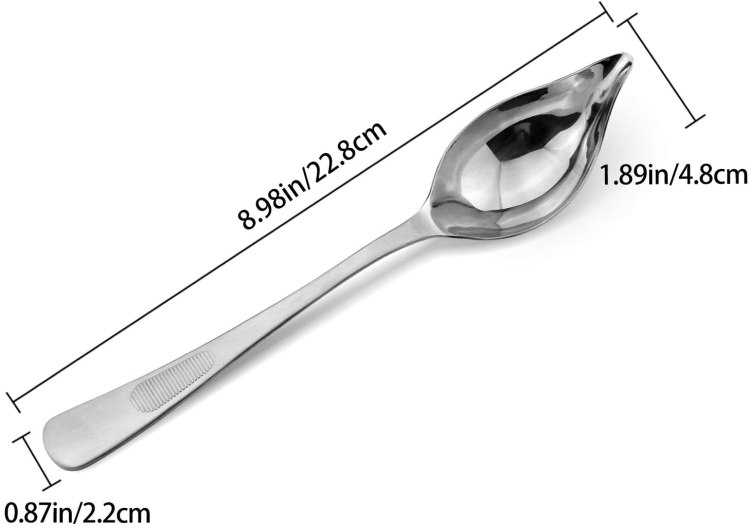
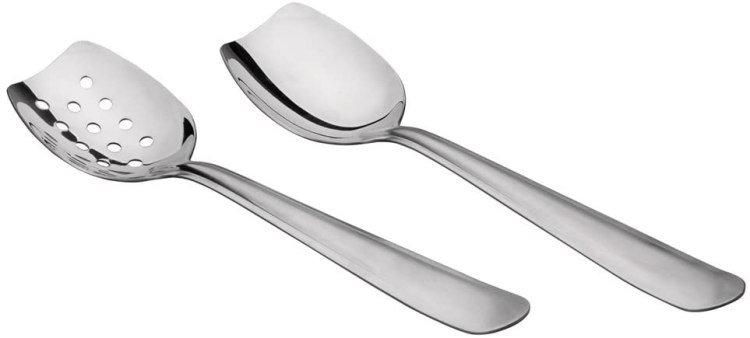
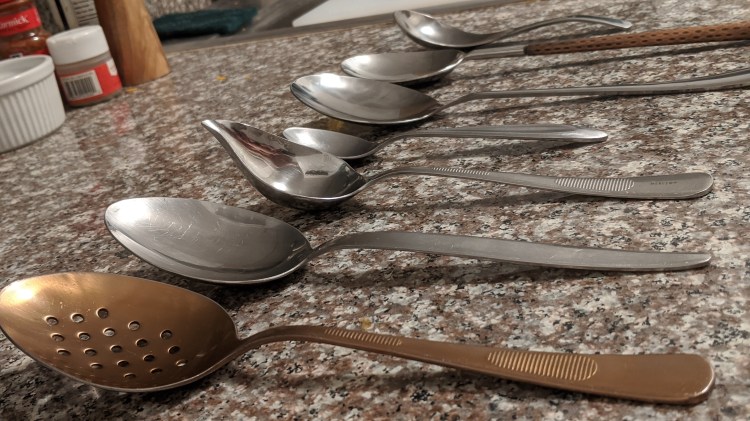
Listed from left to right: the Slotted, the Kunz, the Saucier, the Taster, the Cheap-One-You-Lend-To-Friends, the One-You-Saw-Online-That-You-Had-To-Buy, the Oddity.

There are few things cooks covet more than spoons. 

It’s an odd notion, outside of context. But at the end of the day every profession has a toolset: a box of things that augment their skills, extend their reach, or grant them superhuman ability. A practitioner must develop trust, familiarity with their tools. And eventually that trust gives way to care, devotion, even a kind of love for these hand extenders and power suits.

You may find yourself asking, but what of the other tools? Why would not certain cooks cling to their pastry brushes, their offset spatulas? Some of the best line cooks I know never set down their pair of tongs, never take a smoke break without securing their knife. Why would these tools not be foremost in the daydreams of the professional chef?

I cannot tell you why. But this I know: across my career I have seen great chefs lament the loss of a misplaced spatula. But I have seen them spit daggers and overturn tables at the loss of a perfect spoon. 

A new knife is exciting for a day, this is true. Cooks leave their stations half-prepped, tools clattering behind to huddle around a new blade. But within hours the excitement dies down as the pristine edge begins its work and joins the toolset. Knife-love is fickle, fleeting; its shine dulls with use, and without proper upkeep its razor wit leaves with it, a loss of body and mind. 

But in the professional kitchen you will catch sideways glances of unabashed longing from even a seasoned line cook over a well-fashioned, eternal spoon. 


The Kunz, in a matte copper finish. A great gift for people who write blog posts about spoons…

After all, a perfect spoon is hard to come by. Many chefs will acclaim the Kunz (pronounced ‘koonz’) spoon, named after recently deceased chef Gray Kunz. Honestly you cannot go wrong with this choice: its mirroring steel, that level lip with its deep bowl. Its perfect weight and balance. The subtle curve of its neck to your palm. In the kitchen hives it’s hard to find a spoon of equal charm. The Michelin-grade queen bees cannot deny its utter extravagance, and the worker drones cannot deny its usefulness. 

But to be clear it is not all bedazzlement and stardom in the spoon-osphere: utility is king, beginning and end. And thus a prepared cook does not merely have a spoon: he has a set, three or four pieces that he has collected across years of searching, and tested with the fires of many kitchens. The Kunz is an ideal first choice, but the next spoon is the true workhorse of of the realm: the slotted spoon. If she is not ladling soups or plating sauces, the slotted is the only spoon a cook may need, the first choice in the hypothetical desert island scenario. Fortunately most cooks are not forced into a sandy exile where they can bring only one item of silverware, but it is good to have your priorities straight.

(Notice above that I did say ‘silverware’. The term is antiquated, but its alternative, ‘flatware’, is absolutely demeaning and not to be used here. The best you can wish for in a spoon is that its neck is long and its bowl is deep. The use case for a flat spoon is to buy in bulk and lend to your friends, sidestepping the worry of potential loss. A misplaced spoon is a tragedy; do not risk it.)


I prefer the slotted spoons with holes instead of slots. But these classics are still the shit.

Beyond the solid Kunz and the slotted, options begin to open up. Your use case will vary. Some cooks need something large and durable, perhaps a basting spoon punched from fifteen-gauge steel sheets.  Others may want something small, an ornate tasting spoon that only just fits your deli cup of beef jus. But in equal parts with function, the third spoon is also about style. A rosey bronze spoon can stand out from the stainless steel, but what about matte black? The history of an antique sterling spoon is captivating, but what of a silicone spoon for use on Teflon? Perhaps an extra-long J.B. Prince, or a teardrop-shaped Mercer? Self-exploration may sound a little indulgent when we are talking about chef tools… But there is a journey to be had, and when it comes to the art of stirring and pouring chefs are just as pretentious as bloggers and critics.

My personal third is a saucier, deep-bowled with a thin tip for pouring. It is a glorious tool, though for me largely just an excuse for showing off. If I were to be cruel, I would say that it tends to be too single-focused, the thorn in my utilitarian paw. Akin to a garlic press, it is a tool I require at most twice a night, and shun otherwise. But it is my third, and I use it well…


Single-functioned, beautifully crafted.

… Ultimately this should not have been my third. What I wanted, what I needed for my third was a quenelle spoon, to assist in forming that perfect football of sorbet or whipped cream. Some would avow skepticism that I do not prefer Kunz for the one-handed quenelle. But no, I have fever dreams of my perfect quenelle spoon, fixations the Kunz simply cannot cut.

In my time I have discovered only a few spoons that fully ingratiated these whims, and as quickly as I found them they were gone, forgotten in the knife bags of other cooks or thrown into the steel belly of an industrial dishwasher, a sacrifice to the kitchen gods. I was foolish not to cling to these immaculate wonders for the treasures they were, and now they are only sad memories, persistent but slowly fading.


The fuck kind of spoons are these?! I will publicly shame you for owning one of these tiny shovels.

The loss of a perfect spoon is a great tragedy. But I might also argue, that perhaps loss is just a part of the journey. And so I continue in my art of stirring and pouring, clinging to my faithful tools and eagerly awaiting the arrival of my perfect third.

Review of My Dog: 3 / 5 ★’s.

Last summer my roommate bought himself a dog: an English mastiff puppy, weighing in at 130 pounds when he first met her. After many bags of dog food and perhaps too many carrots, she’s a bit bigger now, and we’ve learned to live together.

But it’s about time to review the dog. Everyone knows you have to review dogs, as a public courtesy. Sadly my roommate has no plans of doing this, and is actually quite stubborn on the topic. So as a co-inhabitant here, I’ve taken this responsibility upon myself.

Verdict: 3 out of 5 stars. This dog is a little droopy, and depressed all the time. She also doesn’t fetch sticks very well, but your mileage may vary. Would recommend, but make sure your model is house-trained. There are no small accidents with English Mastiffs…

So first off, some quick positives. She likes bones, which is a check in her favor. And she plays nice with other dogs, also a plus. 

However she is a little too curious I would say, though I believe that’s only really life-threatening if you’re a cat. And she cannot fetch for the life of her; she just watches me throw the stick, looks at me, and seems to say “Well then I don’t want the stick either.” She doesn’t actually say anything of course.

Oh and she naps all the time. I mean, aaaallll the time. I would be jealous of her, if I wasn’t a responsible adult with blogs to write and groceries to pick up. In this way she’s kind of a bad example to others, if I’m being honest.

And she sheds like a fir tree! After a long day of work I often come home to her making snow angels in her own fur, or jumping into piles of it like leaves in August. She might have a vendetta against the vacuum cleaner, but I’ll need more observation to prove this.

She also has these annoying ways of trying to get your attention, butting into your leg with her nose or staring longingly at you from across the room. Quite bothersome, I must say. But I don’t know how to train her otherwise, so I just pet her and feed her carrots.

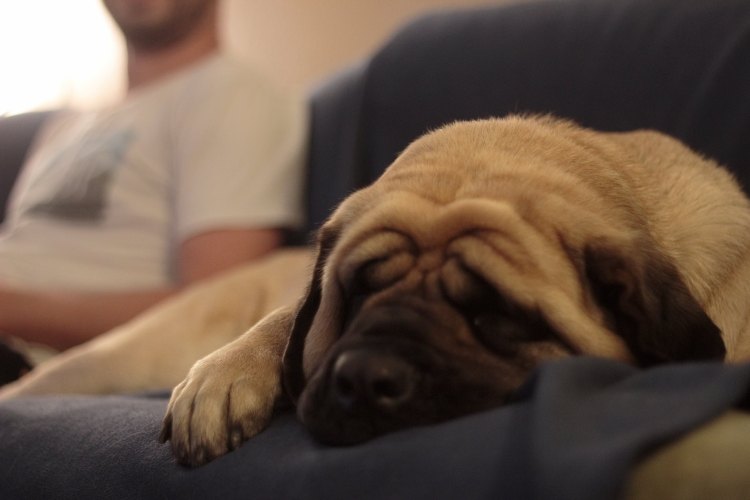
But the biggest problem with having an English Mastiff? She’s always so sad! I mean look at her.

It’s like she saw a very sad ghost or something. I mean, you gotta cheer up girl! The world is full of beautiful things, things to outweigh the pains and crises of the human race. You don’t have to worry about those things; all you have to do is bark at cats and run around in yards. We’ll worry about the rest! But it’s no use, she remains absolutely inconsolable.

So all in all I think I would still recommend this experience. One year in, and about the worst she can do is make me cry with her down-trodden jowls. I’ve got much bigger things to worry about, so all in all this dog co-inhabitant heartily approves.

And she is a good dog, isn’t she? What a good dog.

Nursing Homes Deserve Our Attention.

Nursing home residents account for 1% of the US population. Covid-19 deaths in nursing homes account for 40% of total US deaths.

This is not acceptable.

With better testing, scientists are beginning to understand how pervasive SARS-CoV-2 has truly been. According to the Wall Street Journal, new studies in Europe have discovered “excess deaths” that would place Covid fatality rates much higher than previously modelled, in this case by 26%. The CDC has said as much for the American public, as well. And with 80% of deaths coming from those 80+ years old, this demographic must become the next great priority in our fight against the novel coronavirus. Things like universal testing for this small subset of society may do wonders for reducing harm and death by the virus, and such efforts are almost certainly within our reach.

But instead of action, those most in charge of the situation have refused to take responsibility. The White House blames governors for poor policy moves, for example requiring nursing homes to take on infected patients. And governors demand coordination and funding on a federal level, which has not occured. The Centers for Medicare and Medicaid Services (CMS) blame subpar health ratings from individual facilities, whereas other researchers suggest otherwise. Progress is far too slow, and nobody wants to take control of the situation. This is not acceptable.

My initial read on the situation aligned with CMS: I worried that lax health standards at certain nursing homes might be a major factor in nursing home outbreaks. This would equate to criminal negligence from the caretakers responsible for the lives of vulnerable Americans. But thus far, the data seems to suggest otherwise. According to the American Enterprise Institute, a right-leaning public policy think tank, there is very high correlation between per-capita Covid deaths within nursing homes and Covid deaths without. In other words, infection rates in nursing homes seem to mirror the rates in their surrounding communities, instead of aligning with specific state-wide policies or nursing home standards. From now, my initial fears of “bad apples” are assuaged.

But this doesn’t leave nursing homes off the hook. And this doesn’t leave states off the hook, either. Here in Southern California, state inspections have not proven effective for safeguarding nursing home residents. On multiple occasions inspectors have given passing grades to care facilities, days before those same facilities announced huge numbers of confirmed cases. If state inspections fail to safeguard the vulnerable during this crisis, then both health standards and the people who enforce them must be reevaluated.

The elderly remain the demographic of highest risk when it comes to Covid-19. This is not news; we’ve known this since the beginning. And this is reason enough to focus more of our efforts at shielding them from the disease. With businesses reopening and Americans going back to work, it’s time to reprioritize our tests, our training, and our equipment for the people most at risk. Because so far, all of this is not acceptable. 

My Completely Accurate Timeline of YouTube and Jenna.

Looking back I can’t quite put a finger on my first Jenna Marbles video. Sifting through my history of Likes, it must have been sometime after the Minecraft Let’s Play scene had calmed down. But it was sometime before PewDiePie started reviewing subreddits…

It must have been after Ze Frank had ended “the show”, but before the premiere of “True Facts”. By then I had definitely stopped listening to the Yogscast podcast while farming mushrooms in Vechs’ Super Hostile maps (no you’re a nerd). And I probably knew who JackSepticEye was, but I certainly wasn’t a fanboy yet.

If memory serves, Jake and Amir were still doing their thing, though their ‘thing’ might have been a little further from their manic-office-sketch beginnings and closer to their soap-opera-bromance ends. It was sometime around the end of Machinima, that seems right… Zisteau had likely started Terraria by then, and Epic Rap Battles of History must have been in full swing. 

This isn’t helping, is it…

I struggle to place the moment, truly; I certainly was not “First!!”, I’ll admit that. But I do wish I had arrived sooner.


I have nascent memories of enjoying ‘How to Mildly Annoy Other People’. And I was utterly sold on ‘Everything is Glue’, though it took a little context to explain to friends. And by the time I had witnessed your drunk magic shows and complete ineptitude at games, I was hooked. Bathtub thoughts and vlogmas and bad apps gave way to tiny furniture and life lessons and a lot of love, with radiant splashes of rhinestones and far too many fake eyelashes.

Slowly things changed on this video-sharing website. My favorite Minecraft Let’s Play server, Mindcrack, began to lose members to internal grievances or the Grind. My obsession with Hannah Hart opened my eyes to Grace Helbig and Mamrie Hart, the Holy Trinity. PewDiePie stopped playing horror games, not because he tired of them but because he ran out. Then he bet the bank on a Disney sponsorship, and lost it all on a bridge in PUBG. The Filthy Frank Show came to a close, and livestream uploads of Super Mario Maker began to take the world by storm. 

Eventually I discovered Half in the Bag from the RedLetterMedia guys. And eventually editor Matt Hunziker turned It’s Alive with Brad Leone into the prized gem of the Condé Nast behemoth. And eventually the Gregory Brothers… the Gregory Brothers never really went away, did they?


The news this week has been rough. (It’s got nothing on the year, don’t get me wrong.) But if you know who Jenna is, you also should have known this day would come. Jenna has always been an icon of compassion and love on the Youtubes. Time and again she has demonstrated her utter care for her online family, and gone to extreme lengths to reduce what little harm she may have ever caused. Jenna Mourey’s actions, both in comparison to other YouTubers and idealistically, have always been demonstrably good. She is a bright spot in the days of millions of people, and her love for her community is latent in every action she has ever taken.

News of her leaving the YouTube space rings tragic for all the viewers and creators who cared to know her. We will miss her dearly, and it’s worth betting she’ll miss us too. We’re family, after all. (Dink.) But we all know that if she ever had any inkling of a suspicion that her content could harm her family, she would not hesitate to end it. This was not a surprise. This was Jenna, all along.

Of course this is not a death knell. There are other outlets for this Leisure Lounger, from social media to livestreams to podcasts. And if you ask me, I don’t think our favorite Virgo will be able to get away from the community she has fostered. I appreciate her example in this situation as much as every other, I look fondly on the time and love she has shared with us, and I eagerly await the next great thing that Jenna ‘Marbles’ Mourey has in store.

Here’s to you, Menna Jarbles. Thanks to you, I will always remember that Peach is the smart one. I will always be slightly weirded out by the friendly, platonic body massage. I will never see Hillary Clinton the same way again. And I will always appreciate the Ratchet Fashion community, from a safe distance.

Your hair is always in my prayers. And I hope to someday find you in Elder Scrolls Online, building pond monuments to your dogs and playing lutes with your elf friends. Cheers.

My Sergeant of Mutually-Assured Destruction

Recently a neighbor of mine asked the apartment manager about buying my car. His name was Angel, and he was a mechanic. I had been meaning to sell the car for quite some time, so this inquiry was a godsend. The manager, Samara, acted as translator for our meeting.

We met in the garage to talk shop and take a look at the item in question: black Jetta, almost twenty years old, stick shift with faux-leather seats. Within minutes we had her running, with Angel checking mileage and the oil level. He asked questions about her history, and I gave passing attempts at Spanish, much to the enjoyment of the others. And the meeting ended amiably, with Angel expressing interest and promising a decision by week’s end.

I feel I handled myself well, but I came away from the encounter shaking. Part of the reason was likely low energy on my part; I hadn’t eaten well that day, just eggs and coffee. But part of this strange angst felt social, as if I hadn’t fulfilled an obligation that may have been expected of me. I hadn’t maintained my car in months, and in fact the registration had been expired since April of last year, fully fourteen months ago. By that point I had started ride-sharing to work if memory serves, so there were no immediate ramifications to postponing a trip to the DMV. And by the time I did get around it, my smog check was out of date. By this time my battery was also dead, so I left the car in my apartment parking space and attempted to forget about it.

I realized viscerally how much this had bothered me, leaving problems like this on the backburner. I hadn’t forgotten about the car this past year. Occasionally I would get little pangs of panic, worry about when I should handle the ‘car situation’. It had become a situation, another thing to ignore in my life. I would wile away my time on YouTube, or drink all night with my roommate, and pretend that something so deferrable would also be unimportant. 

But that’s not how it goes. These panic pangs, these minor heart attacks are not and never have been ‘fine’. These problems are both easy to solve for and bear avoidable penalties, like failing to unsubscribe from a newspaper you never read. This combination made my car situation and others like it a high-value problem, something well worth completing. 

So why didn’t I do it? Why hadn’t I simply spent the time, cut the situation into tasks and checked them off one by one? For this question I have no rational answer. It seems to me that I treat certain stresses with avoidance, taking my internal sense of obligation and heightening it to a global imperative, and painting the ramifications of neglect as world-ending. Basic paranoia stuff, very Cold War. But then the cool hippie guy in my head turns to the Sergeant of Mutually-Assured-Destruction and vibes, “Dude, why don’t you relax? If it’s a big deal it’ll be a big deal later. Let’s just be cool.” Then they go smoke some weed or something.

Turns out, this isn’t a great way to live. Painting every sidestepped task as catastrophic doesn’t help me finish things. And the remedial “chill out” is a great relief here, but it wouldn’t be necessary if my Sergeant wasn’t screaming in the first place. This is all avoidable if I can learn to weigh my daily tasks more rationally. But in the end all I really had to do, was go and fix the stupid car. Come on.

Moral of the story is, don’t let your panic pangs be part of your day. Learn to take care of the things that bother you, because the weight of angst and unhappiness will never be worth their postponement.

Dev Exit.

I’ve been watching a lot of Super Mario Maker 2 recently, speedruns and Let’s Play’s and livestreams. It’s a great game, with a great community built around it. It’s mechanics-heavy, but its difficulty curve is only as high as you set it. It’s a nostalgia piece with roots in the 1980’s, but it’s also a modern take on content creation, akin to what YouTube does for video. Collaboration on best strategies is common, and necessary for high-skill levels. Perhaps the most interesting thing to note of this community is its emergent lexicon: with time a language has developed between players to denote the specific problems and challenges the game has to offer. The Shell Jump, The Reclaim, the triumph and dismay of CP1: each of these designate common, recognizable situations in SMM2. This all adds up to a completely gorgeous game, simple enough for an elevator pitch and rich enough for thousands of hours of play, if you’re into this kind of thing.

My favored sub-genre is the Kaizo, originating in the modding community around Super Mario World. These levels tend toward extreme difficulties, completable only with immense platforming skill and careful knowledge of mechanics from the players who dare attempt them. Mischief is a theme here for creators, with hidden Kaizo blocks to stunt a player’s jump, or surprise enemies dashing into the player from off-screen. Altogether the sub-genre makes for a punishing but rewarding challenge, with discovery as a pillar of gameplay. Failure is expected, and in fact integral to finishing a given level.

The rules, or lack thereof, governing this grand repository of custom levels make for a chaotic player experience. Through-lines are non-existent, which might be expected given the Super Mario source material: Nintendo has never been a storyteller’s game company. (Fight me, Zelda fans.) Ultimately all a creator must do to prove his level worthy of Mario canon, is to complete the level himself. Depending on his creation, this task can take quite a few tries, with some claims of trial runs taking many hours. After all, particularly with Kaizo levels, difficulty is a goalpost.

But with this high skill demand, a trend has appeared among certain levels. Some creators, upon crafting an excruciatingly-painful course, find they cannot complete the level themselves. So in pursuit of truly mythic difficulty, they resort to a much-maligned alternative: the Dev Exit. The Dev Exit is a hidden path that allows for finishing a course without traversing its more treacherous straits. Perhaps a secret vine allows the creator to scale a wall and run over the top of the level. Or maybe an arbitrary enemy holds the key to a door that drops you right beside the finish line. 

Using a Dev Exit creators can publish truly insane levels, to the consternation of Kaizo players. And indeed players tend to deride these alternative paths as cheatey, or disingenuous in nature. There is a feeling of reciprocity in a creator completing the troublesome level they created, some meritocratic respect from the community. In this way a Dev Exit isolates its creator from Kaizo players, a stranger looking in rather than a paying member. But given the simple requirements for publishing a level, there is no true penalty for using a Dev Exit in your level. Nintendo has no policy against this phenomenon, and the best a player who discovers a Dev Exit can do is downvote the level.

To some, the ramifications for this kind of laissez faire governance is a poisoned player experience. In lieu of difficult-but-possible platforming, players must sometimes attempt levels that simply cannot be finished in the proposed way. This thought devours some players, making them suspicious whenever they cannot make a jump, or dodge a fireball. Justified Difficulty feels more like impossibility when every level might harbor a Dev Exit, and without Justified Difficulty you cannot have Kaizo. But I think these disillusioned Kaizo players are in the minority, and indeed the Dev Exit is one of the more telling components of Super Mario Maker culture. In this community, players have not taken it upon themselves to boycott devs who use Exits. Instead, as when facing the challenge of the Shell Jump, the Reclaim, or the inevitable Kaizo Block, these players carefully learn the mechanics therein. As with any SMM2 problem worth solving, there are telltale signs of a Dev Exit’s presence, conspicuous rooms where hidden blocks should be or difficulty spikes that suggest alternative paths. Community assistance is paramount as with other mechanics. And with practice, strong players and competent creators can spot secret exits as soon as they enter a room. This in turn leads to more obtuse Dev Exits, and eventually new strategies for players spotting them. The cycle of creator-player culture continues.

The common theme of the Kaizo is certainly its dedication to extreme difficulty. But I think it bears repeating that mischief is its sub-theme, as vital to its challenge as humor is to a dramatic film, or salt is to a great dessert. And when dealing with a mischievous creator, the best one can do is learn to recognize the mechanics, and with practice discover how to overcome them. The Dev Exit does not mark the end of the Kaizo: rather it should have been expected from its definition.